


What keeps me dreaming of going back to the Nordics is that it never feels like a single experience. It’s not just the landscapes, or the cities, or even the Northern Lights. Though Aurora Borealis alone is worth the trip I must say. It’s the contrast. The way places like Norway’s fjords and Helsinki’s granite cities can exist in the same region and feel like they belong to entirely different worlds.
In the summer, the days stretch into something almost surreal. The light hangs in the sky late into the night, soft and strange, and no photo ever quite gets it right. Sometimes it’s the silence. The kind that feels deep rather than empty. And sometimes it’s simply the feeling of being somewhere that hasn’t been overworked by tourism yet. In the Nordics, that feeling still exists if you know where to look.
Norway’s Fjords In Context
Norway’s fjords were carved by glaciers during the last ice age. These waterways were carved around 10,000 years ago, and the result is something that feels almost unreal when you’re standing inside it.
The Sognefjord stretches inland for over 200 kilometers and drops to depths of more than 1,300 meters. The Nærøyfjord is one of its narrowest branches and a UNESCO-listed stretch. The cliffs rise so steeply on both sides that the fjord feels compressed, like the world has been folded in on itself. At its tightest point, it narrows to just a few hundred meters, and the scale of the surrounding walls is hard to process until you’ve been sitting there for a while.
Norwegian Fjord cruises operate across a range of formats, from large international cruise liners that include the fjords as a single port stop to small local ferries that form part of the working transport network for fjord-side communities.

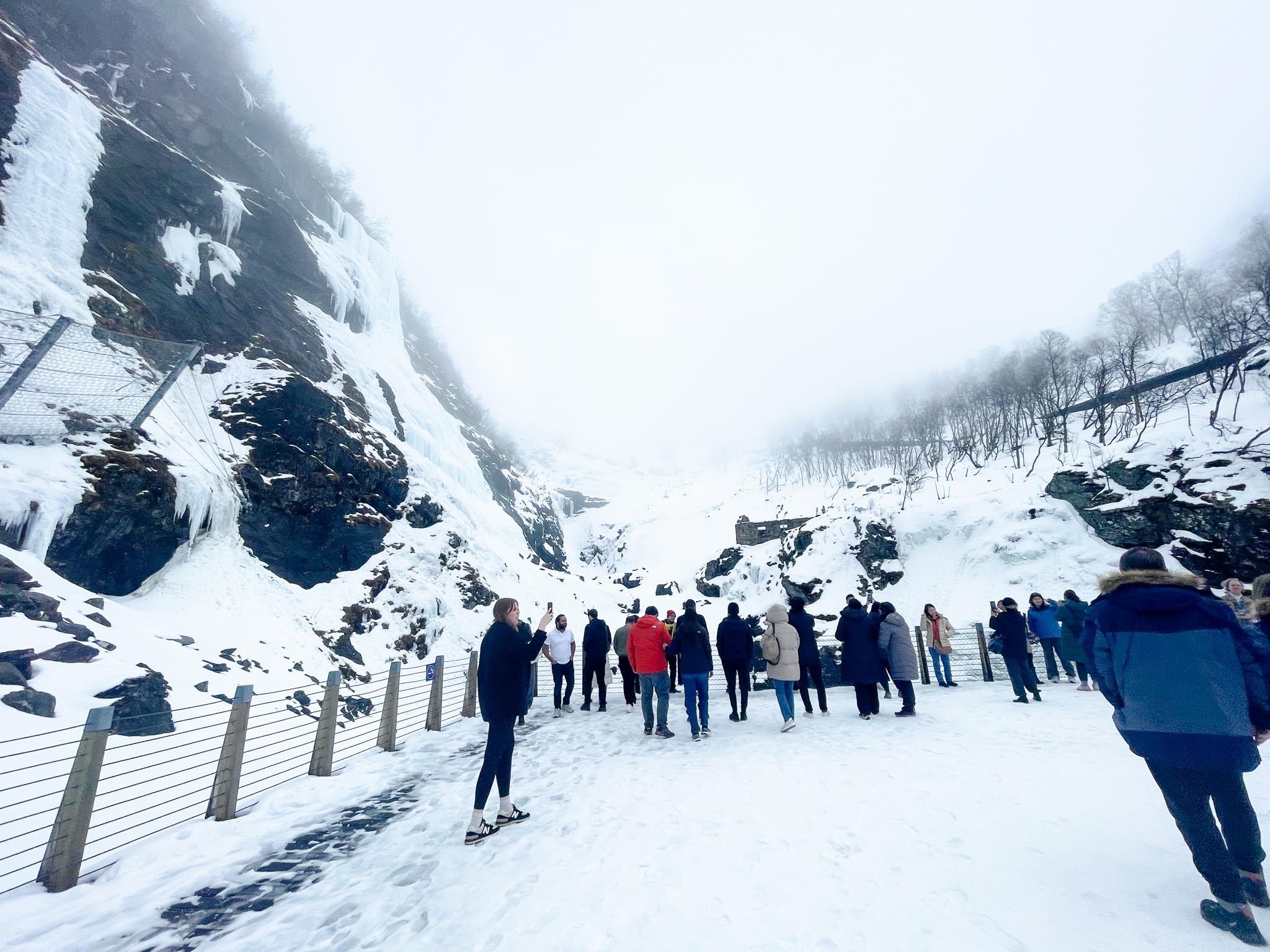
The Communities along Norway’s Fjords
What I love most about western Norway is how naturally life adapts to the terrain. Everything feels shaped by water and mountains first, and human planning second.
Some places, like Flåm, have clearly grown into tourism hubs over time. But just a short ferry ride away, I’ve found villages like Undredal, tiny, quiet places where life continues much as it has for generations. It’s a village of only a few dozen people, known for its goat cheese, and it doesn’t feel staged for visitors in any way. It just exists, and you’re allowed to pass through it.
Even getting around feels like part of the story. Roads like the Aurlandsvegen climb high above the fjords and only open when the snow melts in spring. I remember stopping at viewpoints more than once just because the scale demanded it. At over a thousand meters above sea level, the entire fjord system looks different. Less like something you’re inside and more like something you’re observing from the edge of the world.
Exploring Helsinki’s Unique Architecture and Coastal Character
Helsinki feels completely different the moment I arrive. It doesn’t try to impress in an obvious way, but it tends to grow on me quickly. It’s a relatively small capital, around 650,000 people in the city itself, and it only became Finland’s capital in the early 19th century when the administrative center moved from Turku under Russian rule.
That history shows up in its structure. The central district, designed largely by architect Carl Ludwig Engel, feels unusually coherent for a European capital. Senate Square in particular has this calm, ordered symmetry that makes the city feel intentionally composed rather than layered over time.
But my absolute favorite is Helsinki Train Station. Designed by Eliel Saarinen and completed in 1919, it’s one of those places that feels both functional and iconic at the same time. The granite façade, the sculpted figures holding globe lamps, the clock tower, it’s a transit hub, but it also feels like an introduction to the city’s identity.


Cool Neighborhoods of Helsinki
What I’ve learned about Helsinki is that it doesn’t give everything away immediately. You have to spend time in its neighborhoods before it really clicks.
Kallio is where you would find small coffee shops, record stores, and bars that feel lived-in rather than curated. It has clearly changed over time, but it hasn’t lost its edge.
Punavuori feels more design-focused, with studios, galleries, and a quieter creative energy that reflects Finland’s strong design culture.
And then there’s the Market Square by the harbor, which is ideal to visit early in the morning when it still feels practical rather than busy. That’s where you will usually find smoked fish, berries, or reindeer meat being sold directly by vendors who clearly do this year after year.
The sea is always present in Helsinki in a way that shapes everything. Even when you’re not thinking about it, it’s there.
Suomenlinna, a UNESCO World Heritage Site
One of the places you absolutely have to visit in Helsinki is Suomenlinna. This UNESCO World Heritage Site is just a short ferry ride from the Market Square. Built across a group of islands in the 18th century, it has passed through Swedish, Russian, and Finnish hands over time, and that layered history is still visible in the structures and pathways.
It’s also a living place, not just a historical site, around 800 people still live there year-round. In the summer, it’s busy with day-trippers, and in colder months when the sea starts to freeze, the islands feel almost isolated. Both versions are worth experiencing, but they feel completely different.

The Contrasts of the Nordics
Norway’s fjords and Helsinki don’t really belong in the same category, even though they sit within the same broad region. One operates on a geological scale that makes me feel physically small. The other works at a human scale that rewards walking, noticing, and slowing down.
That shift in perspective is exactly why combining both works so well in a single trip.
If it’s your first time and you really want to see the Northern Lights, I’d go from late September to late March. I won’t mind the cold, and honestly, I think it’s part of the experience. As the Norwegians and Finns like to say, there’s no such thing as bad weather, only bad clothing.

